
KYANITE
From Industry to Jewelry

Kyanite is a fascinating mineral found in a variety of geological environments around the world. It has attracted interest for both its natural occurrence and its uses in different fields, from industry to jewelry.
1. What Is Kyanite
Kyanite is a striking aluminium silicate mineral, also known as “disthene,” “rhaeticite,” or “cyanite.” Its crystals form in the triclinic crystal system, the most unsymmetrical of all crystal structures, giving each stone a unique appearance.
2. The Meaning and Colors of Kyanite
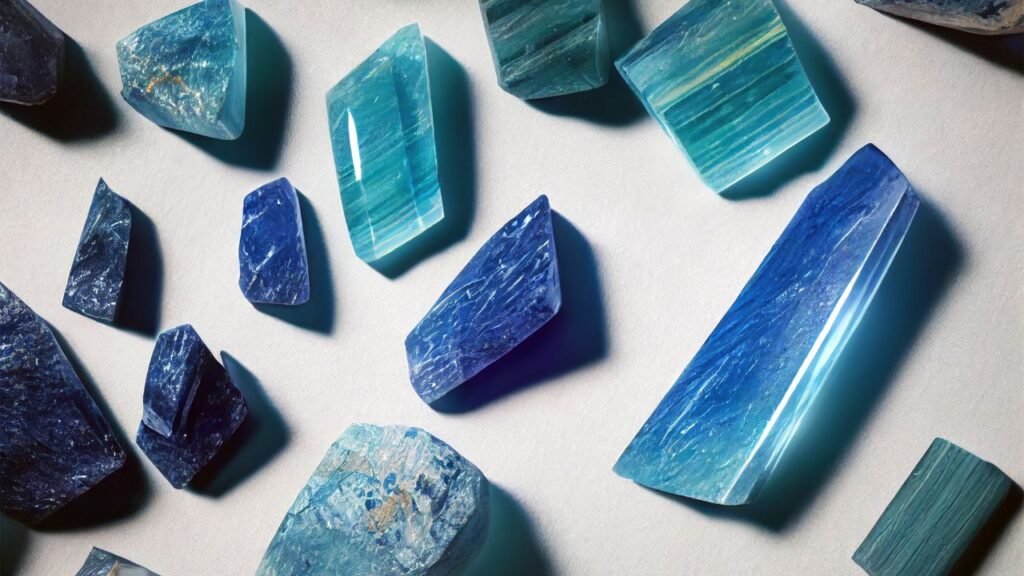
The name Kyanite comes from the Greek word kyanos, meaning “deep blue.” This reflects the mineral’s most common color. However, Kyanite is not limited to blue. It can also appear in white, pink, green, grey, yellow, orange, or colorless forms. Each color is influenced by specific elements within the mineral, making every piece a unique expression of nature’s chemistry.
3. What Causes Kyanite’s Colors
Kyanite’s vibrant colors are caused by the presence of different trace elements. Titanium and iron create its signature blue shade, sometimes enhanced by chromium. Green hues come from vanadium, while fiery orange tones are due to manganese. This variety makes Kyanite a visually stunning mineral, capable of producing gemstones that are as versatile as they are beautiful.
4. From Industry to Gemstone
Historically, Kyanite was used for industrial purposes such as ceramics, refractory materials, electronics, abrasives, brake shoes, and clutch facings. Its transformation into a gemstone began in the 1990s with the discovery of gem-quality specimens. Since then, Kyanite has captured the attention of collectors and jewelers, bridging the gap between practical mineral and exquisite gemstone.
5. Directional Hardness
One of Kyanite’s most remarkable features is its directional hardness. When measured along its long axis, Kyanite ranks between 4 and 4.5 on the Mohs scale, but across its axis, it can reach 6 to 7.5. This unique property means that only skilled and experienced lapidaries can cut it successfully.
6. Origins of Kyanite
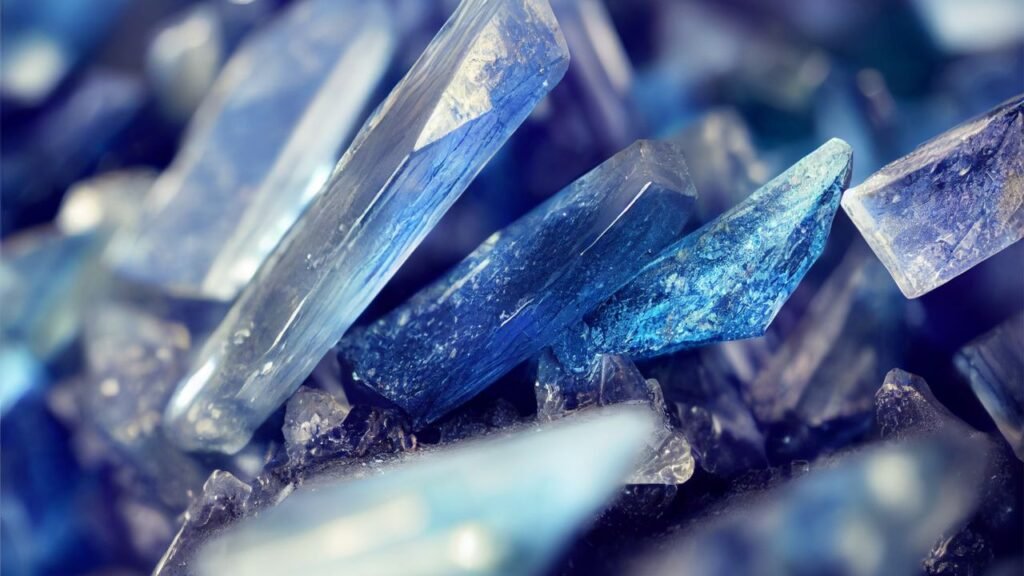
Kyanite can be found in many parts of the world, including the United States, Brazil, Kenya, Mozambique, Tanzania, Nepal, Switzerland, Austria, Russia, and Myanmar. Each region contributes to the mineral’s diversity, producing stones with unique colors and qualities.
7. How to Clean Kyanite
The safest cleaning method is to use warm soapy water and a soft toothbrush, avoiding harsh chemicals or ultrasonic cleaners. With proper attention, your Kyanite can remain radiant for years, preserving both its color and its natural energy.
8. Refractive index
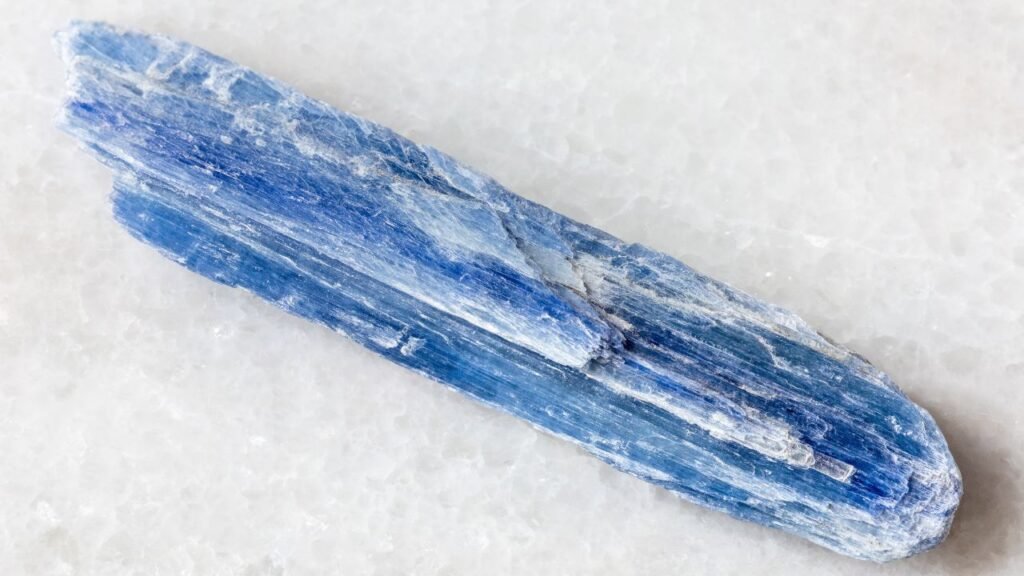
Kyanite typically has a refractive index of 1.716–1.731, with values varying depending on the direction in which the stone is measured. This variation is related to kyanite’s strong optical anisotropy and is useful for identifying the mineral.
Inspired by the remarkable beauty of kyanite, discover the Gemstone Fusion Wall Art Collection, a curated set of three artistic pieces designed to capture the unique colors and character of this extraordinary gemstone.

📌 Kyanite: Summary
- Aluminum silicate mineral
- Also called disthene or cyanite
- Colors: blue, green, pink, grey, yellow, orange, colorless
- Blue color from iron and titanium
- Known for blade-like crystal formations
- Hardness: 4–4.5 (length), 6–7.5 (across)
- Used in industry and jewelry
- Found worldwide: Brazil, Nepal, USA, Kenya, Russia
- May show chatoyancy (cat’s eye effect)