
CLASSICAL MUSIC
Part 3 (c.1750–1820)
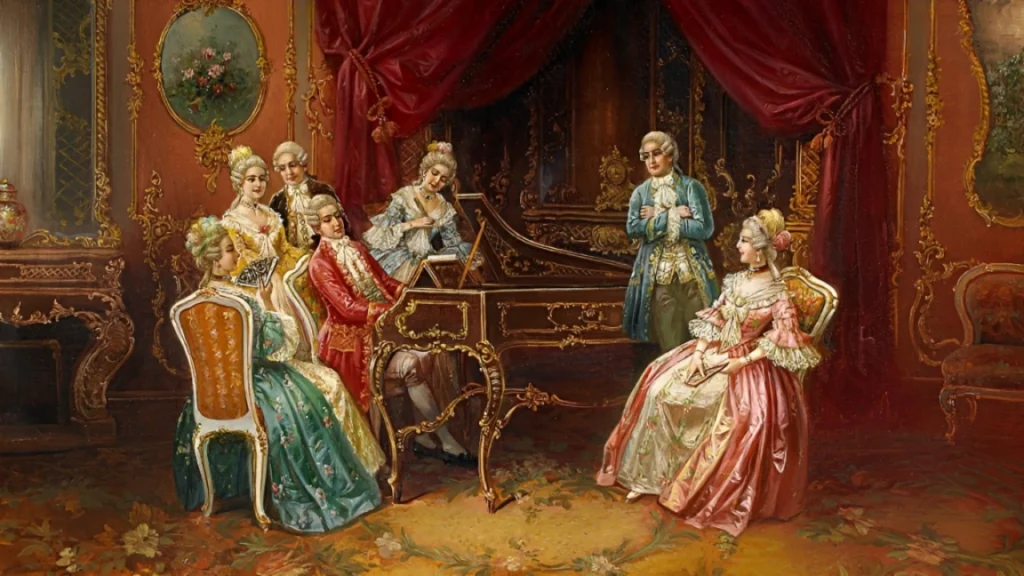
1. German National Anthem (J. Haydn)
The melody of the German national anthem was composed in 1797 by Joseph Haydn (c.1750–1820) for the hymn “Gott erhalte Franz den Kaiser,” written in honor of Emperor Francis II of Austria. In 1841, August Heinrich Hoffmann von Fallersleben wrote new lyrics to this melody, creating the Deutschlandlied (“Das Lied der Deutschen”), which expressed the idea of German unity rather than loyalty to a monarch.
The song became widely associated with the movement for German unification and was adopted as the national anthem in 1922 during the Weimar Republic. After 1952, only the third stanza was officially designated as the national anthem of the Federal Republic of Germany, a status later reaffirmed after German reunification in 1990–1991.
Today, only the third stanza is used officially. The first stanza is generally avoided due to its historical association with the Nazi era, although it is not illegal to perform.
2. Moonlight Sonata (Ludwig van Beethoven)
The Moonlight Sonata, officially titled Piano Sonata No. 14 in C-sharp minor, Op. 27, No. 2, was completed by Ludwig van Beethoven (1770–1827) in 1801 and dedicated to his pupil, Countess Giulietta Guicciardi. The work was already popular during Beethoven’s lifetime. The name Moonlight Sonata was not given by Beethoven himself; it emerged after his death, inspired by a poetic description comparing the first movement to moonlight reflected on water.
3. String Quartets in D MAJOR Op.64, Adagio Cantabile (J. Haydn )
Joseph Haydn (1732–1809) composed the String Quartets, Op. 64 as a set of six works in 1790, during his mature period as a composer. Together with Op. 54 and Op. 55, they are known as the “Tost” quartets, named after Johann Tost, a Hungarian violinist and later merchant who helped arrange their publication and to whom Haydn dedicated Op. 64. These quartets are celebrated for their structural clarity, expressive depth, and refined dialogue between the four instruments, with the D major quartet—“The Lark”—being especially admired for its soaring violin melody.
4. Melody from "Orfeo ed Euridice"(C. W. Gluck)
Orfeo ed Euridice is an opera composed by Christoph Willibald Gluck (1714–1787), based on the ancient myth of Orpheus and set to a libretto by Ranieri de’ Calzabigi. It belongs to the genre of mythological opera and features prominent choruses and dance sequences. The work was first performed at the Burgtheater in Vienna on 5 October 1762, in the presence of Maria Theresa. It became the first of Gluck’s so-called “reform” operas, in which he sought to move away from the complex plots and highly ornate style of opera seria. Instead, he aimed for clarity, emotional truth, and what he called “noble simplicity” in both music and drama.
5. String Quartet In D Major Op.64, Manuetto Allegretto (J. Haydn)
Joseph Haydn (1732–1809) composed his String Quartets, Op. 64 in 1790, a set of six works reflecting his mature style. They belong to the “Tost quartets,” named after the Hungarian violinist Johann Tost, who performed Haydn’s music and helped secure its publication, contributing to its spread across Europe.
Test your knowledge and collect: 🪙 & ⭐